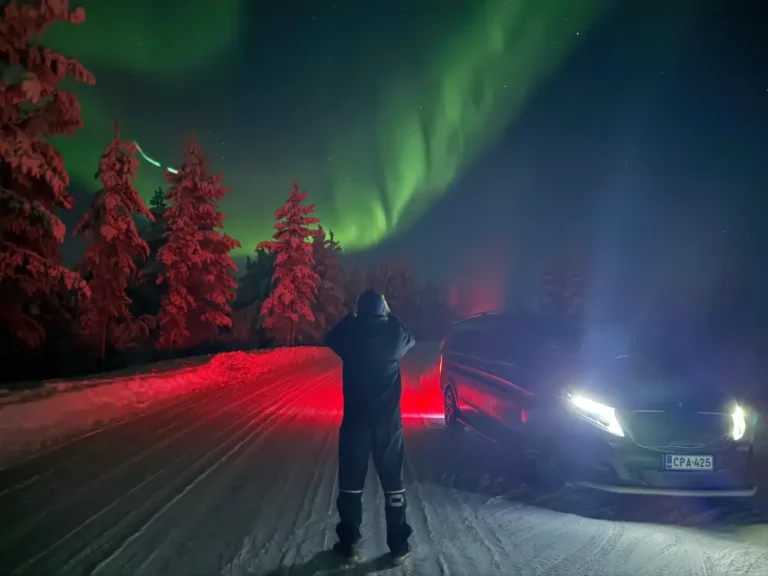
Finnish Lapland in winter is one of the most extraordinary places on earth to witness the Northern Lights. The skies above Saariselkä regularly come alive with curtains of green, violet and white light, but turning that potential into an actual sighting takes more than good luck. A private aurora hunting tour gives you the best possible conditions: a knowledgeable local guide, a vehicle reserved for your group alone and carefully chosen viewing spots far from artificial light. To make the most of that opportunity, a little preparation goes a long way.
This guide walks you through exactly how to prepare for an aurora hunting tour in Lapland, from what to pack and how to dress, to managing expectations and capturing the moment on camera. Explore our Northern Lights tours to see what a private aurora experience in Saariselkä looks like, and read on to make sure you arrive fully ready.
What to Bring on an Aurora Hunting Tour
Pack with purpose before you leave your accommodation. The right items will keep you comfortable during outdoor stops and help you make the most of every moment under the Arctic sky. Forget something essential and the cold will remind you quickly.
Start with the basics and build from there. Many items are small and lightweight, so there is no reason to leave them behind. Here is a practical checklist of what to bring:
- Fully charged smartphone or camera with extra batteries or a power bank (cold drains batteries fast)
- Memory cards with enough storage for a full evening of photography
- Hand warmers for keeping fingers functional during outdoor stops
- A headlamp or small torch for navigating in the dark without ruining your night vision
- Snacks and a reusable water bottle to stay energized during the tour
- Any personal medication you may need, including motion sickness tablets if you are sensitive to travel on forest roads
- A sense of patience, aurora hunting involves waiting, and the right mindset makes the experience far more enjoyable
Your guide will handle navigation, location selection and timing. Your job is to arrive ready to step outside, look up and enjoy the show. With your bag packed, the next step is making sure your body stays warm enough to actually do that.
How to Dress for Arctic Temperatures at Night
Dressing correctly for a winter night in Finnish Lapland is one of the most important things you can do before your private aurora hunting tour. Nighttime temperatures in Saariselkä regularly drop to minus 15 to minus 30 degrees Celsius between November and March. Standing still outdoors in those conditions without the right clothing is uncomfortable at best and genuinely dangerous at worst.
The layering system is the foundation of staying warm in the Arctic. Follow these steps when getting dressed:
- Base layer: Wear merino wool or moisture-wicking thermal underwear directly against your skin. Avoid cotton, which retains moisture and chills quickly.
- Mid layer: Add a fleece or down jacket over your base layer to trap body heat.
- Outer layer: Put on a windproof and waterproof shell jacket and trousers over everything else to block Arctic wind and snow.
- Feet: Wear wool socks and insulated, waterproof winter boots rated to at least minus 30 degrees Celsius. Cold feet will end your evening early.
- Head and hands: Cover your head with a warm hat or balaclava that protects your ears. Use insulated gloves or mittens, and consider liner gloves underneath for camera work.
- Face: A neck gaiter or face covering protects exposed skin from wind chill during outdoor stops.
If you are arriving from a warmer climate and do not own proper Arctic gear, do not worry. Many Lapland accommodations and tour operators provide thermal suits and boots. Check in advance whether outerwear is included with your tour so you can plan accordingly. Once you are dressed and warm, the next priority is choosing the right moment to go out.
Choose the Right Time and Conditions for Aurora Viewing
Timing and conditions are everything when it comes to aurora hunting. The Northern Lights are a natural phenomenon driven by solar activity, and they appear most clearly under specific conditions. Understanding what to look for helps you set off at the right moment and trust your guide’s decisions on the night.
The aurora season in Finnish Lapland runs from late August through early April, with the darkest and most productive months typically falling between October and March. Within that season, several factors determine your chances on any given night:
- Clear skies: Cloud cover is the single biggest obstacle. Even strong aurora activity is invisible through thick cloud. Your guide will monitor weather forecasts closely and select locations where skies are clearest.
- Solar activity (Kp index): The Kp index measures geomagnetic activity on a scale from 0 to 9. In Lapland, auroras are often visible from Kp 2 upward. Apps such as Space Weather Live or My Aurora Forecast give real-time readings.
- Darkness: The aurora appears after sunset and before sunrise. Aim to be outside between 10 pm and 2 am when darkness is deepest. Avoid going out during the brief twilight windows in late autumn.
- Distance from artificial light: Light pollution washes out faint auroras. A private tour takes you to carefully selected wilderness locations where the sky is genuinely dark.
Check the Kp forecast and local weather the afternoon before your tour. Share what you find with your guide, who will factor it into the evening’s plan. With conditions understood, the next step is adjusting your mindset before you head out.
Set Realistic Expectations for Your Aurora Experience
The Northern Lights are one of nature’s most spectacular displays, but they are not a ticketed performance. Setting realistic expectations before your private aurora hunting tour protects your enjoyment and ensures the experience remains memorable regardless of what the sky delivers.
The aurora is a natural phenomenon that cannot be guaranteed. Even with perfect conditions, solar activity is unpredictable. Some nights produce dramatic, sweeping curtains of light that last for hours. Other nights bring brief flickers or nothing at all. Experienced guides do everything possible to find the best conditions, but no one controls the sky.
Here is what you can realistically expect from a well-run private aurora tour:
- A knowledgeable guide who monitors conditions and moves to better locations if needed
- Transportation to dark-sky areas away from tourist crowds and light pollution
- An unhurried pace that follows your group’s preferences rather than a fixed schedule
- Warm drinks and a comfortable environment during outdoor stops
- A beautiful Arctic landscape worth experiencing even on a quiet aurora night
Approach the evening as an Arctic wilderness experience first and an aurora hunt second. Guests who do this consistently report that the tour itself, the silence of the Lapland wilderness, the stars, the snow and the company, is rewarding even when the lights are subtle. Book a private aurora hunting tour and let the evening unfold on its own terms.
Prepare Your Camera for Night Sky Photography
Capturing the Northern Lights on camera requires a different approach than daytime photography. The low light, the movement of the aurora and the cold all create challenges that catch many visitors off guard. Prepare your camera settings in advance so you are not fumbling with menus in the dark when the lights appear.
A DSLR or mirrorless camera with manual controls gives you the most flexibility, but modern smartphones with pro or night modes can also produce impressive results. Follow these steps to get your camera ready:
- Use a tripod: Long exposures are essential for aurora photography. A stable tripod is non-negotiable. Even a lightweight travel tripod works well.
- Set your lens to its widest aperture: Use f/2.8 or wider to let in as much light as possible.
- Choose a high ISO: Start at ISO 1600 and adjust up or down depending on aurora brightness. Very active auroras may allow lower ISO settings.
- Set a shutter speed between 5 and 15 seconds: Shorter exposures capture fast-moving auroras more sharply. Longer exposures work better for faint, slow-moving displays.
- Focus manually: Autofocus struggles in darkness. Switch to manual focus and set it to infinity, then fine-tune until stars appear sharp in your viewfinder.
- Shoot in RAW format: RAW files retain far more detail than JPEGs and give you much greater flexibility when editing afterward.
- Keep spare batteries warm: Store them in an inner pocket close to your body. Cold kills battery life rapidly, and you will want backup power ready.
Test your settings at home or in your accommodation before the tour. Take a few test shots in a dark room or outdoors at night to confirm your camera is behaving as expected. Arriving with a working setup means you can focus on the experience rather than the equipment when the aurora appears.
Know What to Expect During the Tour Itself
Understanding how the evening unfolds helps you relax and enjoy it fully. A private aurora hunting tour is not a rigid itinerary. It is a flexible, guided experience that adapts to conditions, locations and your group’s pace. Here is a clear picture of what a typical evening looks like.
Your guide will collect your group directly from your accommodation. You will travel in a comfortable, heated vehicle to locations selected based on that evening’s cloud cover, wind direction and aurora forecast. The guide may drive to multiple spots throughout the night if conditions shift or if a clearer sky is found elsewhere in the region.
During the tour, you can expect:
- Outdoor stops at dark-sky wilderness locations where you can set up your camera and watch the sky
- Guidance from your local guide on what to look for and how to photograph what you see
- Hot berry juice and local snacks by an open fire at suitable stops
- Freedom to ask questions, adjust the pace and stay at a location as long as conditions are good
- A return journey to your accommodation once the evening’s best opportunities have passed
Dress in your warmest layers before pickup. Arrive with your camera ready and your expectations open. The wilderness around Saariselkä is stunning even under a quiet sky, and the experience of standing in the Arctic dark, watching for light to appear, is something most guests describe as unforgettable regardless of what the aurora delivers that night.
If you have specific questions about what to bring, what to wear or how the tour is structured, get in touch with us and we will be happy to help you prepare. When you are ready to secure your spot, book your private aurora hunting tour directly and we will take care of the rest. You can also learn more about our Northern Lights tours to find the option that fits your group best.