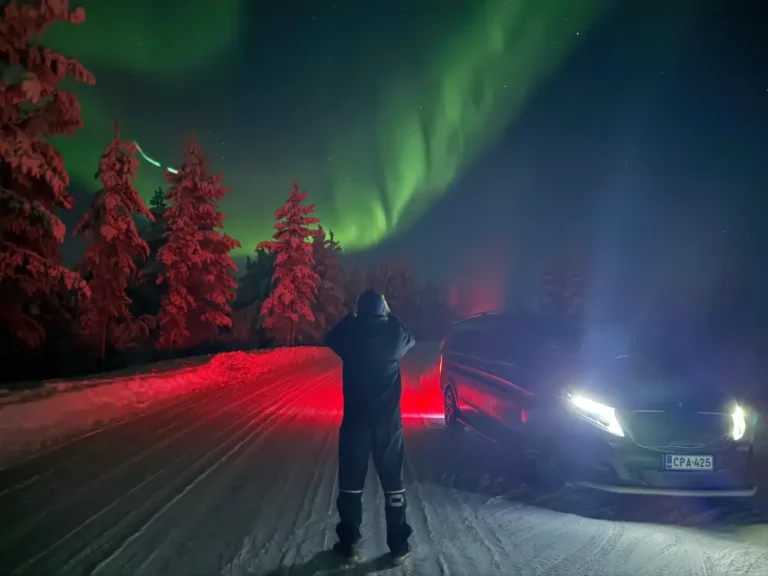
Yes, you can meaningfully increase your chances of seeing the Northern Lights by choosing a private aurora tour over a shared group experience. The single biggest factor is flexibility: a private guide can move quickly, change location, and stay out longer based on real-time conditions rather than a fixed schedule. The sections below answer the most important questions about how aurora viewing actually works and what gives you the best odds.
If you want to experience the aurora borealis in Finnish Lapland with a guide dedicated entirely to your group, explore our Northern Lights tours or book a private aurora hunting tour directly.
What actually determines whether auroras appear on a given night?
Aurora visibility depends on three independent factors: solar activity, atmospheric conditions, and the darkness of your viewing location. All three must align on the same night. Solar activity, measured by the Kp index, determines whether a geomagnetic storm is strong enough to push aurora activity to your latitude. Cloud cover is the most common reason people miss the lights entirely. And light pollution can wash out even a strong display.
Solar activity follows roughly eleven-year cycles, with periods of high activity producing stronger and more frequent auroras. During a solar maximum, geomagnetic storms occur more often and the aurora borealis can appear at lower latitudes and with greater intensity. The Kp index ranges from 0 to 9, and for Finnish Lapland a reading of 2 or above is often sufficient to produce visible activity, though stronger events create far more dramatic displays.
Cloud cover is entirely separate from solar activity and is the factor most likely to ruin an otherwise promising night. A sky full of geomagnetic energy means nothing if thick clouds are blocking the view. This is why experienced guides monitor weather patterns across a wide area and are prepared to drive to clearer skies when conditions change.
Finally, the darkness of your viewing position matters more than many travellers expect. Artificial light from hotels, roads, and resort areas competes directly with the aurora, making faint displays nearly invisible. Getting away from light sources is not optional; it is essential.
How does a private aurora tour improve your odds compared to a group tour?
A private aurora tour improves your odds primarily through flexibility and speed. On a shared group tour, the guide must follow a fixed route and return time that works for every participant. On a private tour, the vehicle and guide belong entirely to your party, so decisions about where to go, when to move, and how long to stay are made in real time based on current conditions rather than a predetermined schedule.
This flexibility matters in practice for several specific reasons:
- Location changes: If cloud cover moves in at one spot, a private guide can immediately drive to a clearer area without needing consensus from a large group or approval from a tour coordinator.
- Extended time outdoors: Private tours can stay out longer if activity is building, rather than cutting the evening short to return guests on a fixed timetable.
- Quiet, undisturbed viewing: Without strangers nearby, there is less noise, less movement, and less disturbance that can detract from the experience when auroras do appear.
- Photography at your pace: Photographers in a private group can take the time they need for long-exposure shots without pressure from other participants waiting to move on.
On a private aurora hunting tour with Private Snow Safaris, the entire evening is built around your group’s preferences and the night’s conditions. No strangers are added to the vehicle. The guide selects viewing locations based on live weather data and local knowledge of the Saariselkä wilderness, choosing spots away from artificial light and tourist crowds.
What tools do guides use to forecast and track auroras?
Experienced aurora guides use a combination of space weather forecasting services, satellite cloud imagery, and local terrain knowledge to plan each evening. The most important tool is the Kp index forecast, which predicts geomagnetic activity up to one to three days in advance. Cloud cover maps and weather radar are checked continuously throughout the evening to identify clear-sky windows.
The primary forecasting resources guides rely on include:
- NOAA Space Weather Prediction Center: Provides Kp index forecasts and alerts for geomagnetic storm activity.
- Finnish Meteorological Institute: Offers detailed cloud cover and weather data specific to Finnish Lapland, often more accurate for local conditions than general weather apps.
- Aurora alert apps: Several apps aggregate real-time Kp data and send notifications when activity rises above a chosen threshold.
- Satellite cloud imagery: Live satellite images allow guides to identify cloud-free corridors and plan driving routes toward clear skies.
Local knowledge adds a layer that no app can replicate. A guide who knows the terrain around Saariselkä understands which valleys tend to hold cloud longer, which elevated areas offer unobstructed northern horizons, and which access roads remain passable in deep winter. This combination of digital tools and firsthand experience is what separates an effective aurora hunt from a passive wait outside a hotel.
How far from light pollution do you need to be to see auroras clearly?
For a clear view of the Northern Lights, you generally need to be at least several kilometres from any significant artificial light source. In practice, this means leaving the lit areas of towns, resort centres, and main roads behind and travelling into open wilderness or forested terrain where the sky is genuinely dark. Even moderate light pollution can mask fainter aurora displays that would otherwise be clearly visible.
Finnish Lapland has a significant natural advantage here. The region has very low population density, and large stretches of wilderness around Saariselkä, Inari, and the surrounding national park areas are genuinely dark. On a clear night far from resort lighting, even a relatively modest Kp event can produce a visible and photogenic display.
The difference between watching from a hotel terrace and watching from a dark wilderness location can be dramatic. A faint green shimmer barely visible near a resort can appear as a clear, structured arc or curtain from a properly dark location a short drive away. This is one of the most practical reasons to go out with a guide rather than simply stepping outside your accommodation and looking up.
Guides at Private Snow Safaris select viewing locations specifically chosen for low light pollution, open sky views, and accessibility in winter conditions. These are not random roadside stops but carefully considered spots where the conditions for seeing and photographing the aurora are as strong as possible.
When is the best time of night to watch for the Northern Lights?
The Northern Lights are most active around local magnetic midnight, which in Finnish Lapland falls roughly between 10 pm and 2 am. This window represents the peak of geomagnetic activity alignment with your location, and aurora displays that appear during this period tend to be stronger and more dynamic than those seen earlier or later in the night.
That said, auroras are not strictly predictable by the clock. A strong geomagnetic storm can produce visible activity from dusk through to early morning, and some of the most memorable displays occur outside the core midnight window. The key is being outside, in a dark location, with clear skies during whatever period of activity occurs.
Patience is a genuine part of aurora hunting. The sky may be quiet for an hour and then erupt with movement and colour. Guides who have spent many seasons in Lapland understand this rhythm and structure the evening to keep guests comfortable and ready during the waiting periods, with warm clothing, hot drinks, and shelter available so that the wait does not become uncomfortable.
Starting the tour around 9 pm and staying out until midnight or later gives the best coverage of the peak window. Private tours have the advantage of adjusting this timing based on the night’s forecast, going out earlier if conditions look promising or extending the evening if activity is building late.
Which months give the highest chance of seeing auroras in Finnish Lapland?
The months with the highest aurora viewing probability in Finnish Lapland are September, October, February, and March. These months combine sufficient darkness with statistically higher geomagnetic activity around the equinoxes, which tend to trigger stronger aurora events. Midwinter months like December and January offer the longest nights but can also bring persistent cloud cover in some years.
Here is a practical overview of the aurora season by month:
- September and October: Darkness returns after the midnight sun period. Skies can be clearer than deep winter, temperatures are cold but manageable, and the equinox effect often boosts geomagnetic activity. Snow may not yet cover the ground, but aurora displays can be excellent.
- November: Full polar night conditions are approaching. Nights are long, temperatures drop significantly, and aurora activity remains strong. Snowfall can bring cloud, but also creates a beautiful landscape backdrop.
- December and January: The darkest months of the year with the longest viewing windows. Cloud cover is a common challenge during this period, but when skies clear, the conditions for seeing the Northern Lights are exceptional. This is also peak travel season for many international visitors.
- February and March: Often considered the sweet spot. Days begin to lengthen slightly, weather patterns can stabilize, and the equinox effect again increases geomagnetic activity. Temperatures remain cold and the snow landscape is at its most scenic.
The aurora season in Finnish Lapland runs from late August through to early April, giving a window of roughly seven to eight months each year. Outside this period, the sky is too bright during summer for auroras to be visible, even when solar activity is high.
If you are planning a trip to Lapland and want to give yourself the best possible chance of seeing the Northern Lights, choosing a private aurora hunting tour with an experienced local guide is the most effective step you can take. The right timing, the right location, and real-time decision-making by someone who knows the terrain are what separate a memorable sighting from a missed opportunity. Book your private Northern Lights tour for the season ahead, or get in touch if you have questions about dates, availability, or what to expect during your time in Finnish Lapland.
Related Articles
- Private aurora hunting designed around your schedule and ideal conditions
- Private aurora hunting experiences tailored for unforgettable night sky adventures
- How to photograph the Northern Lights on a Private Aurora Tour?
- Private Aurora Hunting in Saariselkä
- What Happens During a Private Northern Lights Tour?