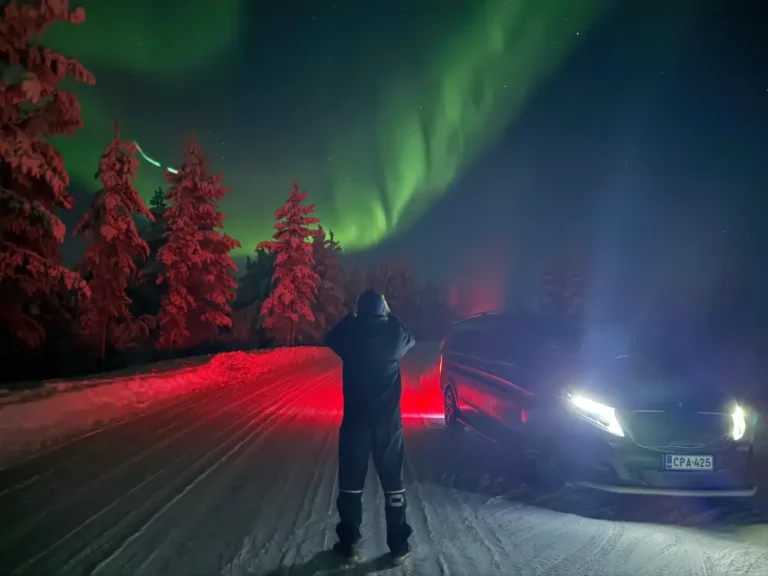
A private aurora hunt gives photographers significantly more control than a shared group tour. You choose when to stop, how long to stay, and which angles to shoot from, without waiting for strangers or following a rigid schedule. For serious aurora photographers, that flexibility is the difference between a handful of usable shots and a genuinely rewarding night under the Arctic sky. The sections below answer the most important practical questions about photographing the Northern Lights in Finnish Lapland.
If you want to experience aurora hunting on your own terms, explore our Northern Lights tours or book a private aurora hunting tour directly.
What camera settings work best for photographing the Northern Lights?
The best camera settings for Northern Lights photography are a wide aperture between f/1.8 and f/2.8, an ISO between 800 and 3200, and a shutter speed of 5 to 15 seconds. These settings allow enough light to reach the sensor while keeping the aurora sharp rather than blurred by its movement. A sturdy tripod and a remote shutter release are essential to avoid camera shake during the exposure.
The exact values depend on how active the aurora is. A bright, fast-moving display benefits from a shorter shutter speed, around 3 to 6 seconds, to preserve the structure and detail in the curtains. A faint or slow aurora may require 15 to 25 seconds and a higher ISO to become visible at all. Shooting in RAW format gives you the most flexibility when editing, particularly for recovering shadow detail in the dark foreground landscape.
Manual focus is necessary because autofocus struggles in low light. Set focus to infinity, then fine-tune by checking a bright star or distant light through your live view at maximum zoom. Once you have a sharp focus point, lock the focus ring in place or use gaffer tape to prevent it from shifting when you handle the camera in the cold.
- Aperture: f/1.8 to f/2.8 (as wide as your lens allows)
- ISO: 800 to 3200, adjusted for the brightness of the display
- Shutter speed: 5 to 15 seconds for a typical display
- Focus: manual, set to infinity and locked
- File format: RAW for maximum post-processing flexibility
- Tripod: mandatory for any exposure longer than a second
Wide-angle lenses between 14mm and 24mm are the most practical choice for astrophotography in Lapland because they capture a large portion of the sky alongside the snowy landscape below. A foreground element, such as a frozen lake, a snow-covered pine or an open fire, adds depth and context to aurora images that would otherwise feel flat.
Why does light pollution ruin Northern Lights photos?
Light pollution ruins Northern Lights photos because artificial light brightens the sky, reducing the contrast between the aurora and the background. When the sky glow from towns, roads and tourist resorts competes with the aurora, the colours appear washed out, detail is lost, and longer exposures become impossible without overexposing the sky entirely.
Finnish Lapland is one of the least light-polluted regions in Europe, but that advantage disappears quickly when you stay close to resort centres. Saariselkä village, for example, produces enough ambient light to noticeably degrade aurora photography within a few hundred metres. Driving even 10 to 20 kilometres into the wilderness, away from roads and settlements, can make a dramatic difference to the quality of the dark sky above you.
Light pollution also affects the human eye’s ability to adapt to darkness. It takes around 20 to 30 minutes for night vision to fully develop, and any exposure to bright artificial light resets that process. Photographers who step out of a lit vehicle or a bright resort lobby are immediately at a disadvantage. A private aurora hunt that takes you away from built-up areas and keeps artificial lighting to a minimum protects both your camera’s results and your own ability to see the aurora clearly.
How does a private aurora tour give photographers more control over timing?
A private aurora tour gives photographers more control over timing because the entire schedule revolves around your party alone. There is no fixed departure time shared with strangers, no pressure to move on when others are cold or tired, and no compromise over how long to stay at a particular location. If the aurora intensifies at midnight, you can stay until it fades rather than returning to the resort on a preset timetable.
Aurora activity is unpredictable by nature. A display may last 10 minutes or several hours, and it can shift from faint to spectacular within seconds. On a shared group tour, the guide must balance the needs of every participant. On a private tour, the guide works entirely for your group, which means pausing when you need to adjust settings, repositioning the vehicle to block wind or improve your angle, and waiting in silence while you compose a long exposure.
Timing also matters for cloud cover. Clouds are the most common reason aurora hunters miss a display, even on nights with high geomagnetic activity. A private guide with local knowledge can drive to a different area where the sky is clearer, spending as much time as needed to find a gap in the cloud. This kind of responsive, mobile aurora hunting is only possible when the group is small, the vehicle is available exclusively to you, and no one else’s schedule needs to be respected.
What locations in Finnish Lapland are best for aurora photography?
The best locations for aurora photography in Finnish Lapland are remote wilderness areas with open sky, dark horizons and minimal artificial light. Frozen lakes, treeless fell summits and wide river valleys offer unobstructed views of the sky in multiple directions. The area around Saariselkä, Inari and Lemmenjoki National Park consistently provides some of the darkest skies in the region.
Frozen lakes are particularly valuable for aurora photographers because the flat, reflective surface creates natural mirror effects when conditions allow, and the open horizon means the aurora can be seen from horizon to horizon without trees blocking the lower portion of the display. Lake Inari, one of the largest lakes in Finland, is a destination in its own right for astrophotography in Lapland.
Fell landscapes above the treeline offer elevation and 360-degree visibility, which is useful when the aurora appears in an unexpected direction. However, exposed fells can be extremely cold and windy in winter, which creates practical challenges for camera equipment and for the photographer’s own comfort. A knowledgeable local guide understands which locations are accessible by vehicle, which offer shelter from the wind, and which provide the best combination of dark skies and interesting foreground elements for composition.
- Frozen lakes near Inari and Saariselkä for open, reflective horizons
- Wilderness roads beyond resort lighting zones
- Fell summits above the treeline for unobstructed 360-degree views
- Lemmenjoki National Park for remote, genuinely dark skies
- River valleys with minimal road traffic and no settlement lighting
How do Arctic temperatures affect camera equipment?
Arctic temperatures affect camera equipment primarily by draining batteries faster, causing lubricants in moving parts to thicken, and creating condensation when cold gear is brought into warm interiors. In Finnish Lapland, winter temperatures regularly fall below minus 20 degrees Celsius, and camera batteries can lose more than half their effective capacity in those conditions. Carrying spare batteries kept warm inside a jacket pocket is essential.
Modern mirrorless and DSLR cameras from major manufacturers generally function at temperatures down to around minus 10 to minus 20 degrees Celsius, but performance degrades before the rated limit is reached. Autofocus slows, LCD screens respond sluggishly, and mechanical shutters can behave unpredictably in extreme cold. Keeping the camera body close to your body between shots and using a padded camera bag helps retain enough warmth for reliable operation.
Condensation is a serious risk that many photographers overlook. When you move a cold camera from the outdoor temperature into a warm vehicle or building, moisture in the warm air condenses on and inside the camera body. This can damage electronics and fog the lens. The safest approach is to place the camera inside a sealed plastic bag before bringing it indoors, allowing it to warm up slowly while moisture condenses on the outside of the bag rather than on the equipment itself.
- Carry at least two or three spare batteries, kept warm in an inner pocket
- Use a padded camera bag to slow heat loss between shots
- Avoid breathing on the lens, as moisture freezes instantly
- Seal the camera in a plastic bag before entering warm spaces
- Allow the camera to acclimatise slowly when moving between temperatures
- Wear thin liner gloves under outer mittens to maintain dexterity
Lens elements can also contract slightly in extreme cold, which occasionally affects focus calibration. If you notice a shift in focus accuracy during a cold night, recheck your infinity focus point rather than assuming the lens has malfunctioned. Most issues resolve once the equipment returns to a moderate temperature.
Should photographers book a private or small-group aurora tour in Lapland?
Photographers should book a private aurora tour in Lapland rather than a small-group tour if capturing high-quality images is a primary goal of the experience. A private tour eliminates the compromises that come with sharing a vehicle and guide with strangers, giving you full control over stops, duration, positioning and pace. For couples or families for whom photography is the main priority, the additional investment is justified by the results.
A small-group aurora tour is a reasonable choice for solo travellers or those for whom photography is secondary to simply witnessing the Northern Lights. Group sizes are kept limited compared to mass-tourism operators, and the experience is still far more personal than a large coach tour. However, the guide must balance the interests of everyone present, which means you may not be able to stay at a particular spot as long as you need for a complex composition or a long sequence of exposures.
The practical differences for photographers come down to three factors:
- Location flexibility: A private guide can drive to a second or third location based entirely on your photographic preferences, not on what works for a mixed group.
- Time at each stop: You decide when to move on. There is no pressure from other participants who are cold, tired or simply not interested in photography.
- Silence and stillness: Long exposures require a stable environment. On a private tour, the guide understands when to keep the group quiet and still during a critical shot.
Private Snow Safaris offers both a private aurora hunting tour and a standard small-group option, so the choice depends on your priorities, group size and budget. If you are travelling as a couple or a small family with serious photographic ambitions, the private format is the clear recommendation. If you are a solo traveller open to meeting others and primarily want to experience the aurora rather than photograph it extensively, the small-group tour delivers excellent value.
Whatever you choose, booking in advance during the 2026 aurora season is strongly recommended. The aurora season in Finnish Lapland runs from late August through to April, with the darkest and coldest months between November and February offering the longest periods of darkness for aurora hunting. To plan the right experience for your trip, view our Northern Lights tours, book your private aurora tour, or contact us to discuss your specific photography goals and travel dates.