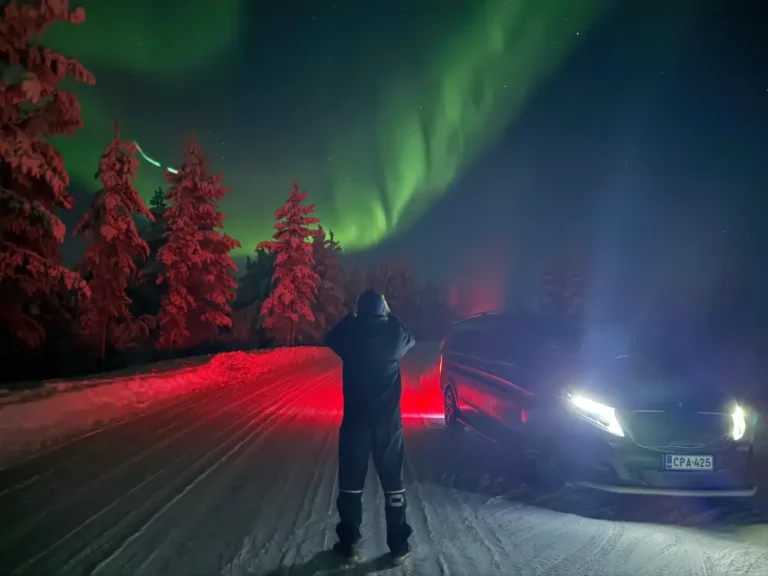
The aurora forecast tells you how likely the Northern Lights are to be active on a given night, based on solar wind data and geomagnetic activity levels. It is a genuinely useful planning tool, but it only tells half the story, cloud cover in Lapland can override even a strong solar forecast entirely. Understanding both factors, and knowing how experienced guides use them together, is what separates a well-planned aurora hunt from a night spent staring at an overcast sky.
If you are planning a Northern Lights tour in Finnish Lapland, knowing how forecasts work will help you set realistic expectations and make smarter decisions about when and whether to head out. This article answers the most common questions travellers have about aurora forecasting, from Kp index basics to what local guides actually check before deciding where to drive.
How accurate is the aurora forecast, really?
Aurora forecasts are reasonably reliable within a short window of roughly one to three hours ahead, but become significantly less precise beyond that. Short-range predictions based on real-time solar wind data measured by satellites near Earth are the most trustworthy. Forecasts looking several days ahead are educated estimates at best, because solar activity is inherently unpredictable and cloud cover adds another layer of uncertainty that no solar model can account for.
The key distinction is between two types of forecasting. Solar activity forecasts predict how energetic the incoming solar wind will be, this is where the Kp index comes in. Weather forecasts predict whether the sky above you will be clear enough to see anything at all. Both must align for a successful aurora viewing night.
In practice, guides in Lapland treat the forecast as a probability indicator rather than a guarantee. A strong forecast on a cloudy night produces nothing visible. A moderate forecast on a perfectly clear, dark night away from artificial light can deliver a breathtaking display. The forecast narrows the odds in your favour, but the Arctic environment always has the final word.
This is why experienced aurora guides do not rely on a single source or check conditions only once. They monitor multiple data streams throughout the evening and remain ready to adapt the route as conditions shift. A forecast that looked poor at sunset can improve dramatically by midnight.
What is the Kp index and what number do you need to see the aurora?
The Kp index is a global scale from 0 to 9 that measures geomagnetic disturbance caused by solar wind interacting with Earth’s magnetic field. Higher numbers indicate stronger geomagnetic activity and a greater likelihood of visible aurora. In Finnish Lapland, which sits well within the auroral zone, the Northern Lights can appear at Kp levels as low as 1 or 2 under ideal dark-sky conditions.
Here is a practical guide to what different Kp levels typically mean for aurora visibility in Saariselkä and northern Lapland:
- Kp 0-1: Very quiet geomagnetic conditions. Aurora may still appear faintly near the magnetic pole, but it is unlikely to be vivid or widespread.
- Kp 2-3: Moderate activity. In the auroral zone, this is often enough for a visible display, especially on a dark, clear night away from light pollution.
- Kp 4-5: Good activity. Strong displays are likely in Lapland, and the aurora may be visible further south in Scandinavia and northern Europe.
- Kp 6-7: High activity. Vivid, dynamic aurora with multiple colours is possible. These nights produce the most dramatic photographic opportunities.
- Kp 8-9: Severe geomagnetic storm. Rare and spectacular. Aurora can appear across much of Europe and North America.
One important nuance: the Kp index is a global average. Local aurora intensity can vary significantly depending on your exact position within the auroral oval, which shifts in real time. This is why guides in Lapland also monitor real-time auroral oval maps rather than relying on Kp alone. A Kp of 2 directly under the oval can outperform a Kp of 4 that passes to the north of your location.
Does cloud cover matter more than solar activity?
Yes, cloud cover is the single biggest practical obstacle to seeing the Northern Lights, and in most cases it matters more than solar activity on any given night. The aurora can be blazing overhead at Kp 6, but if there is a solid cloud layer between you and the sky, you will see nothing. In Finnish Lapland, cloud cover is also highly variable across short distances, which is why mobility is one of the most important tools an aurora guide has.
Lapland’s weather patterns mean that a location that is completely overcast can be separated from clear sky by as little as 30 to 60 kilometres. This is precisely why private aurora tours with flexible routing have a meaningful advantage over tours that drive to a fixed location and wait. A guide who monitors cloud cover maps in real time can navigate around overcast areas and position the group under a clear patch of sky when the aurora is active.
Cloud cover forecasting for aurora purposes uses the same meteorological tools as standard weather forecasting, but aurora guides pay particular attention to satellite imagery that shows cloud movement in near real time. Finnish Meteorological Institute data, combined with satellite cloud cover overlays, give a much clearer picture of where the sky is actually open than a standard weather app will provide.
The practical conclusion: on a night with a weak solar forecast but perfectly clear skies, your chances of seeing the aurora are often better than on a night with a strong solar forecast and heavy cloud cover. Always check both, and prioritise finding clear sky first.
What tools and apps do aurora guides actually use?
Experienced aurora guides in Lapland use a combination of real-time solar wind data, auroral oval tracking, satellite cloud imagery, and local weather forecasts, typically across several different platforms simultaneously. No single app captures the full picture, which is why professional guides build their own monitoring routine from multiple sources.
The most commonly used data sources among aurora guides include:
- NOAA Space Weather Prediction Center: Provides real-time solar wind speed and density data from the DSCOVR satellite, which is one of the most reliable short-range aurora indicators available.
- SpaceWeatherLive: Presents live Kp index data, real-time Bz (the north-south component of the interplanetary magnetic field), and auroral oval maps in a readable format.
- Windy or similar meteorological platforms: Used to visualise cloud cover movement across Lapland in near real time, allowing guides to identify clear corridors.
- Finnish Meteorological Institute (FMI): Provides localised weather data for Finnish Lapland that is often more accurate for the region than international weather apps.
- Aurora alert apps: Several apps send push notifications when Kp rises above a set threshold, which is useful for monitoring conditions during an evening without checking dashboards constantly.
Beyond digital tools, local knowledge plays a role that no app can replicate. Guides who operate regularly in the Saariselkä region know which areas clear first when cloud breaks from the west, which elevated spots offer the widest sky view, and which roads remain passable after heavy snowfall. This combination of data and terrain knowledge is what makes a well-guided private aurora hunt meaningfully different from checking an app yourself and driving to a random forest road.
How does the forecast affect when and where a private aurora tour goes?
On a private aurora hunting tour, the forecast directly shapes the timing, route, and destination of the evening. Rather than following a fixed itinerary, the guide monitors conditions in the hours before departure and adjusts the plan based on where the sky is clearest and when solar activity is most likely to peak. This flexibility is one of the core advantages of a private tour over a group excursion with a predetermined schedule.
In practical terms, the forecast influences the tour in several ways:
- Departure timing: If solar activity is forecast to increase later in the evening, the guide may plan a later start or extend the tour into the early hours of the morning when conditions are optimal.
- Route selection: Cloud cover maps determine which direction the vehicle heads. If overcast conditions dominate to the east, the route shifts west or north toward clearer sky.
- Location choice: Viewing spots are selected for minimal light pollution, open sky views, and safe access. The specific location is chosen on the night based on conditions, not booked in advance.
- Duration and stops: On nights with strong solar activity and clear sky, the guide may extend time at a particularly good location or add stops to maximise the experience. On quieter nights, the group may move more frequently to find the best conditions.
This real-time adaptability is what a private aurora hunting tour with Private Snow Safaris is built around. The vehicle, guide, and schedule belong entirely to your group, which means decisions are made based on what gives you the best possible chance of seeing the Northern Lights, not what fits the logistics of a larger shared group.
Should you book an aurora tour even when the forecast looks weak?
Yes, you should book an aurora tour even when the short-term forecast looks weak, for two important reasons. First, aurora forecasts beyond a few hours are unreliable, and conditions can change dramatically within a single evening. Second, a weak Kp forecast does not mean no aurora, in Finnish Lapland’s auroral zone, faint displays are possible even at low activity levels, and a clear, dark sky often reveals more than the numbers suggest.
Many of the most memorable aurora sightings happen on nights when the forecast was unimpressive. A quiet Kp of 2 or 3 combined with perfect clear sky, total darkness, and a knowledgeable guide who positions the group in the right location can produce a beautiful, photogenic display. Conversely, guests who wait for a “perfect” forecast night sometimes find that high Kp and heavy cloud cover produce nothing visible at all.
There are also practical reasons not to wait. If you are visiting Lapland for a limited number of nights, every clear night is an opportunity. Aurora season in northern Finland runs from late August through April, but the peak visiting window for most travellers is November through March. Within a one-week trip, you might have only two or three genuinely clear nights. Skipping one because the forecast looked moderate could mean missing the best display of your stay.
The honest position is this: no one can guarantee you will see the Northern Lights, and any guide or tour operator who promises otherwise is not being truthful. What a well-organised private tour can guarantee is that you are in the right place, at the right time, with the best available local knowledge working in your favour. That is the most any aurora hunter can do.
If you are ready to plan your evening in Finnish Lapland, explore our Northern Lights tours to see what a private aurora experience looks like in practice. For questions about timing, conditions, or what to expect during your stay, get in touch with our team directly, we are happy to help you plan around the best possible window. When you are ready to confirm your night out, you can book your private aurora hunting tour and let us take care of the rest.
Related Articles
- What is included in a private Northern Lights tour in Finnish Lapland?
- Private aurora hunting that puts you exactly where the lights appear
- Can you increase your chances of seeing auroras privately?
- How to photograph the Northern Lights on a Private Aurora Tour?
- Book your private aurora hunt and witness nature's greatest light show