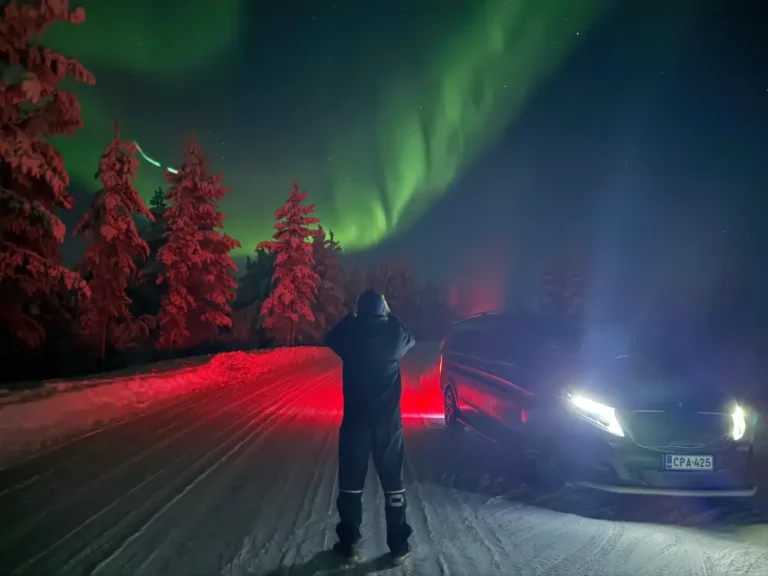
Yes, you can see the Northern Lights from Saariselkä. Located well above the Arctic Circle in Finnish Lapland, Saariselkä sits inside the auroral zone, the band around the Earth where the Northern Lights appear most frequently. On clear, dark nights between autumn and early spring, the Aurora Borealis is a realistic and achievable experience here, not a rare stroke of luck. The sections below answer the most common questions about timing, conditions, clothing, and how to give yourself the best possible chance of witnessing the lights. Explore our Northern Lights tours to see how a private aurora experience in Saariselkä works.
How Good Is Saariselkä for Seeing the Northern Lights?
Saariselkä is one of the best locations in Europe for Northern Lights viewing. Its position above the 68th parallel places it firmly within the auroral oval, where geomagnetic activity produces visible aurora displays far more reliably than locations further south. The surrounding wilderness, low population density, and minimal light pollution make it an outstanding base for aurora hunting.
Unlike larger Finnish cities or more developed resort areas, Saariselkä is surrounded by open fell terrain and ancient forests. This geography makes it easy to escape artificial light within minutes of leaving your accommodation. The darkness here is genuine, and even a moderate aurora display can be clearly visible to the naked eye.
The region also benefits from its relatively stable winter weather patterns compared to coastal Arctic locations. While cloud cover is always a factor anywhere in Lapland, the inland position of Saariselkä means it often experiences clearer skies than coastal areas to the north and west. Local guides who know the terrain can move between locations to find gaps in the clouds, a significant advantage over staying in one fixed spot.
Aurora activity itself depends on solar conditions rather than geography, but Saariselkä’s position within the auroral zone means that when activity occurs, this area is well placed to receive it. Guests staying in the region during the right season have a genuinely strong chance of seeing the lights across multiple nights.
What Time of Year Are the Northern Lights Visible in Saariselkä?
The Northern Lights are visible in Saariselkä from late August through early April, with the peak season running from October to March. Aurora displays require darkness, so the midnight sun period from late May to mid-July makes sightings impossible. The darkest months of November, December, and January offer the longest windows of darkness each night.
Here is a practical breakdown of the aurora season in Saariselkä:
- Late August to September: The first dark nights return after summer. Nights are short but aurora activity is possible, and autumn colours add a scenic backdrop.
- October to November: Darkness increases significantly. Snow typically arrives in October, creating classic Lapland winter conditions. This is one of the best periods for aurora hunting.
- December to January: The darkest time of year, with polar night in December meaning the sun barely rises above the horizon. Long dark windows give multiple opportunities each night.
- February to March: Daylight returns but nights remain long and cold. Clear skies are common in late winter, making this another excellent period. Snow conditions are typically at their best.
- Early April: The season draws to a close as nights shorten rapidly. Aurora sightings are still possible in early April but windows become brief.
For travellers visiting Saariselkä in 2026, the core aurora season runs from autumn through to early spring. If seeing the Northern Lights is a priority, aim to visit between October and March and plan for several nights in the region rather than relying on a single evening.
What Conditions Do You Need to See the Northern Lights?
Three conditions must align for a Northern Lights sighting: sufficient solar activity, a clear sky, and genuine darkness. All three are necessary, high solar activity means nothing if the sky is overcast, and a perfectly clear night produces no aurora if geomagnetic conditions are calm. Understanding these factors helps set realistic expectations.
Solar activity is measured using the Kp index, a scale from 0 to 9. In Saariselkä’s auroral zone location, a Kp level of 1 or 2 is often enough to produce visible aurora on a clear night. Higher Kp levels bring stronger, more dramatic displays that can fill the entire sky with colour. Solar activity follows roughly 11-year cycles, and the current solar cycle has been producing elevated activity, which is good news for aurora hunters visiting in the coming years.
Cloud cover is the most unpredictable variable and the one that most often determines whether a tour succeeds. Even strong aurora activity is invisible through thick cloud. This is why mobility matters, a guide who can drive between locations has a meaningful advantage over waiting in one fixed spot. In Saariselkä, the open fell landscape and surrounding wilderness provide multiple potential viewing areas that can be reached quickly.
Darkness is the third essential ingredient. Artificial lights from towns, hotels, and roads wash out faint aurora displays. Moving away from light sources, even just a short distance from your accommodation, makes a significant difference in how clearly the lights appear. The wilderness around Saariselkä provides natural darkness that is difficult to find in more urbanised parts of Europe.
Patience is also a practical requirement. Aurora displays are unpredictable in timing. The lights may appear briefly and then fade, or build slowly over several hours. Spending a full evening outdoors rather than checking for a few minutes gives you a far better chance of witnessing a meaningful display.
Does a Private Aurora Tour Increase Your Chances of Seeing the Lights?
Yes, a private aurora tour meaningfully increases your chances compared to watching from a fixed location. The main advantage is mobility, a knowledgeable local guide can monitor cloud cover, track aurora forecasts in real time, and drive your group to locations where conditions are best. This flexibility is not available to guests who wait on a hotel terrace or visit a single designated viewing spot.
Private aurora hunting also removes the constraints that come with shared group tours. On a large shared tour, the route and timing are fixed around the group as a whole. A private tour adapts to conditions as they develop, staying out longer when activity increases or moving to a different area when clouds roll in. The guide’s sole focus is on your group, not on managing a large crowd with mixed expectations.
Local expertise adds another layer of advantage. Guides who know the Saariselkä region understand which terrain features block wind, which elevated areas offer the clearest sky views, and which forest roads lead away from any residual light pollution. This knowledge is built over seasons of aurora hunting in the same landscape, it cannot be replicated by checking a forecast app.
A private aurora hunting tour with Private Snow Safaris places a premium vehicle, a dedicated local guide, and a flexible itinerary entirely at your group’s disposal. The tour is reserved exclusively for your party, meaning no strangers join your experience and the schedule follows your group’s pace. If you are travelling as a couple, family, or private group and the Northern Lights are important to you, a private tour is the most effective approach available.
What Should You Wear and Bring on a Northern Lights Tour in Lapland?
On a Northern Lights tour in Lapland, you need warm, layered clothing that protects against temperatures that can drop to minus 20°C or lower during clear winter nights. Standing still outdoors in Arctic conditions is significantly colder than being active, so warmth is the priority. Thermal base layers, an insulating mid-layer, and a windproof outer layer form the foundation of a suitable outfit.
Here is a practical packing list for a Saariselkä aurora tour:
- Base layer: Merino wool or synthetic thermal top and leggings, avoid cotton, which loses insulation when damp
- Mid-layer: A fleece or down jacket for insulation
- Outer layer: A windproof and waterproof jacket and trousers
- Footwear: Insulated, waterproof winter boots rated for extreme cold, regular trainers or fashion boots are not suitable
- Accessories: Warm hat covering your ears, a neck gaiter or balaclava, and insulated gloves or mittens
- Face protection: A thin balaclava or face mask for very cold nights when wind is a factor
- Camera equipment: If you plan to photograph the aurora, bring a camera capable of manual settings, a tripod, and extra batteries kept warm in an inner pocket
Private Snow Safaris provides thermal overalls and warm boots as part of the tour experience, so guests do not need to purchase specialist Arctic clothing before travelling. However, wearing your own warm base layers underneath significantly improves comfort, especially on the coldest nights. If you are unsure what to bring, your guide can advise you before the tour begins.
Hand warmers are a small but worthwhile addition, particularly for photographers who spend time with bare fingers adjusting camera settings. Keeping your phone in an inner pocket preserves battery life in the cold, which matters if you want to use it for photography or communication during the tour.
What Happens If the Northern Lights Don’t Appear During Your Tour?
If the Northern Lights do not appear during your tour, the experience still takes place as planned, aurora hunting is an outdoor Arctic adventure, and the evening in the Lapland wilderness has value independent of whether the lights appear. The Northern Lights are a natural phenomenon and cannot be guaranteed by any tour operator anywhere in the world, and responsible operators are clear about this from the outset.
What a well-run private aurora tour offers is the best realistic conditions for a sighting, the right location, the right timing, local expertise, and the flexibility to respond to changing conditions. On any given evening, cloud cover or low solar activity may prevent a sighting despite all of these advantages. This is the honest reality of aurora hunting, and it applies equally to every operator in Lapland.
The experience of spending a clear Arctic night in the Finnish wilderness, surrounded by snow-covered trees, breathing cold fresh air, watching the stars in conditions of near-total silence, is memorable in its own right. Many guests who do not see the aurora on their first evening describe the experience as one of the most peaceful and striking of their trip. Hot berry juice by an open fire, the depth of the Arctic darkness, and the company of a knowledgeable local guide all contribute to an evening worth having.
For guests who are staying in Saariselkä for several nights, the practical advice is to book a tour early in your stay rather than on your final night. This gives you the option to go out again if conditions were not favourable on the first attempt. Aurora activity is variable, and guests who spend multiple evenings looking for the lights significantly improve their overall chances across a stay.
If you have questions about timing, conditions, or what to expect, contact us directly, our team is happy to help you plan your aurora experience around your travel dates and accommodation. To reserve your evening in the Lapland wilderness, book a private aurora hunting tour and let our local guides take care of everything from pickup to the return journey.