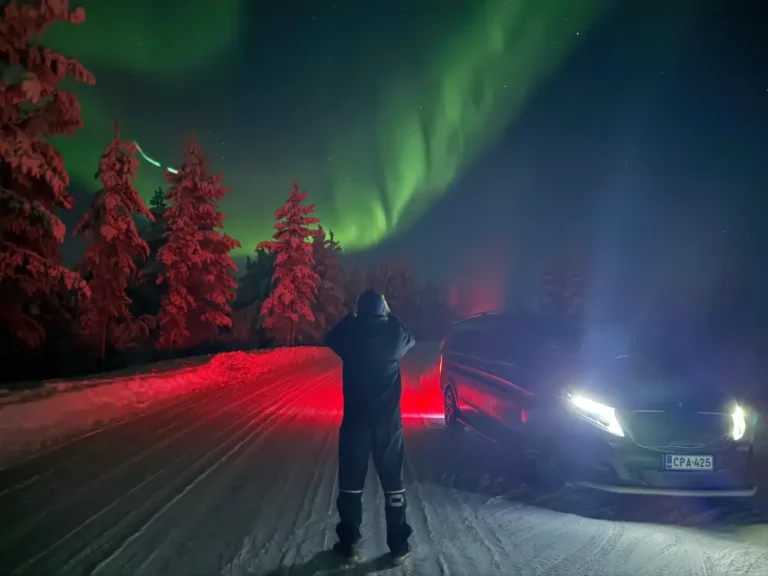
On a private aurora hunting experience, you can expect a flexible, personalized evening spent searching for the Northern Lights in carefully chosen locations away from light pollution and tourist crowds. Your guide monitors weather conditions and cloud cover in real time, moving to wherever conditions look most promising. The tour is reserved exclusively for your group, so the pace, timing and stops are entirely shaped around you. Below, this article answers the most common questions travellers have before booking their first aurora hunting tour in Finnish Lapland.
If you are ready to plan your evening under the Arctic sky, explore our Northern Lights tours or book your private aurora hunting tour directly.
How do guides choose where to go aurora hunting?
Aurora hunting guides choose locations by combining real-time cloud cover forecasts, light pollution maps and local knowledge of the terrain. The goal is to find an open sky with minimal cloud obstruction and no artificial light interference. In Saariselkä and the surrounding Finnish Lapland wilderness, experienced guides know which clearings, frozen lakes and elevated spots offer the widest, darkest skies on any given night.
Before the tour begins, guides check multiple weather services and aurora forecast tools to assess where cloud cover is thinnest. Because Arctic weather changes quickly, the chosen route may shift during the evening. A guide who knows the region well can make those decisions fast, driving toward clearer skies rather than waiting in one place and hoping for improvement.
Local knowledge is what separates a skilled aurora guide from a GPS route. Knowing which forest road opens onto a frozen lake, which hillside faces north, or which valley stays sheltered from wind requires years of experience in the area. This is why guides based in Saariselkä bring a genuine advantage over anyone working from a map alone.
- Real-time cloud cover and weather monitoring
- Light pollution avoidance using wilderness locations
- Knowledge of local terrain, clearings and viewpoints
- Flexible routing to follow the clearest skies during the evening
What are the best conditions for seeing the Northern Lights?
The best conditions for seeing the Northern Lights are a clear, dark sky combined with strong geomagnetic activity. Cloud cover is the single biggest obstacle, so a cloudless night matters more than almost any other factor. Darkness is also essential, which is why Finnish Lapland between late September and late March offers ideal conditions, with long polar nights and minimal light pollution.
Geomagnetic activity is measured on the Kp index, which runs from 0 to 9. Even a Kp level of 1 or 2 can produce visible aurora displays in Finnish Lapland, because the region sits far enough north that auroras appear lower on the horizon and are easier to observe. Higher Kp values produce stronger, more colourful and more widespread displays, but a low Kp night with a perfectly clear sky can still deliver a memorable experience.
Timing within the night also matters. Aurora activity tends to peak in the hours around local magnetic midnight, which in Saariselkä falls roughly between 10 pm and 1 am. Being outside during this window, away from artificial lights and with eyes adjusted to the dark, gives you the best realistic chance of witnessing the aurora borealis.
- Clear skies with no cloud cover
- Low or zero artificial light in the viewing area
- Kp index of 1 or above (higher means more intense displays)
- Visiting between late September and late March
- Being outside between approximately 10 pm and 1 am local time
How long does a private aurora hunting tour typically last?
A private aurora hunting tour in Finnish Lapland typically lasts between two and four hours, depending on conditions, the group’s preferences and how the evening unfolds. Tours usually begin around sunset or shortly after and extend into the darkest hours of the night, when aurora activity is most likely to peak.
Because private tours are not tied to a fixed group schedule, the duration can flex. If the Northern Lights appear early and your group wants to stay longer to photograph them, the guide can extend the time in the field. Equally, if conditions look unfavourable in one location, the guide may drive to a different area, which naturally adds time to the outing.
Unlike a shared group tour where the bus must return at a fixed hour for everyone, a private aurora experience gives your party genuine control over the evening. Some groups choose to stop for hot drinks and snacks by an open fire mid-tour, adding a memorable pause that makes the experience feel less like a transfer and more like a genuine Arctic adventure.
What should you wear and bring on an aurora tour?
On an aurora tour in Finnish Lapland, you should dress in warm thermal layers and bring hand warmers, a fully charged camera and a portable power bank. Temperatures during aurora season regularly fall below minus 15 degrees Celsius and can drop much further, so warmth is the top priority. Standing still outdoors for extended periods in Arctic cold requires significantly more insulation than walking or skiing.
Most reputable aurora tour operators provide thermal suits, boots and gloves as part of the experience, which removes much of the guesswork. Even so, wearing a good base layer underneath the provided clothing makes a meaningful difference to your comfort during the tour.
Clothing checklist
- Thermal base layer (top and bottom)
- Warm mid-layer such as a fleece or down jacket
- Thermal suit provided by the operator, worn over your layers
- Warm socks, ideally wool
- Insulated boots (usually provided)
- Hat, balaclava or neck gaiter
- Warm gloves or mittens (usually provided)
What to bring
- Camera with manual settings for long-exposure photography
- Portable power bank, as cold drains batteries quickly
- Spare batteries for your camera, kept warm in an inner pocket
- Hand warmers for extra comfort during photography stops
- A small backpack if you are carrying personal items
Leave large suitcases and unnecessary luggage at your accommodation. The goal is to stay warm, move freely and focus on the sky above you.
How is a private aurora tour different from a group tour?
A private aurora tour differs from a group tour in that the vehicle, guide and entire evening are reserved exclusively for your party. No strangers join the group, and the itinerary is shaped around your preferences rather than a fixed schedule designed for the largest number of people. This distinction matters significantly for couples, families and anyone who values flexibility, privacy and a more personal experience.
On a shared group tour, the guide must balance the needs and pace of every participant. Departure and return times are fixed, stops are predetermined and photography opportunities are shared among the whole group. If the lights appear while the bus is in transit, the stop may be brief. If your group wants to linger at a particular location, that is rarely possible when others are waiting.
On a private tour, the guide can stop wherever the sky looks best, wait as long as the group wants and adapt the route based on real-time conditions without compromise. Families with young children can return earlier if needed. Photographers can stay out longer. Couples can enjoy the silence of the Arctic night without a crowd around them.
- Private tour: Your group only, flexible timing, personalised route, stops adapted to your wishes
- Group tour: Mixed participants, fixed schedule, predetermined stops, shared photography time
What happens if the Northern Lights don’t appear?
If the Northern Lights do not appear during your tour, it is almost always due to cloud cover or low geomagnetic activity on that particular night. The aurora borealis is a natural phenomenon and cannot be guaranteed by any operator, regardless of how experienced or well-equipped they are. Honest operators are clear about this from the outset rather than making promises they cannot keep.
What a skilled guide can control is the effort made to find the best possible conditions. This means monitoring forecasts before and during the tour, relocating to clearer areas when cloud cover moves in and staying out long enough to give activity a genuine chance to develop. An experienced guide in Finnish Lapland will not park in one spot and wait passively; they will work actively throughout the evening to maximise your chances.
On nights when the aurora does not show, the experience still has real value. Driving through the Arctic wilderness after dark, stopping beside a frozen lake under a sky full of stars, warming up with hot berry juice by an open fire and experiencing the deep silence of a Finnish winter night are all meaningful in their own right. Many guests describe those quiet moments as among the most memorable parts of their time in Lapland.
If you are concerned about missing the lights, consider extending your stay in Lapland to give yourself multiple evenings with the possibility of aurora activity. The more nights you are available, the greater your realistic chance of witnessing a display. You can also contact us to discuss your travel dates and get honest advice about conditions during your planned visit.
A private aurora hunting experience in Finnish Lapland offers far more than a simple bus ride to a dark field. It is an expertly guided, personally tailored evening in one of the world’s best aurora destinations, built around your group’s comfort and curiosity. Whether the lights paint the sky green and violet or the stars alone fill the darkness, the experience of being out in the Arctic wilderness with a knowledgeable local guide is something most travellers remember long after they return home. View our Northern Lights tours to see what is included, or book your private aurora hunting tour and start planning your Lapland evening under the Arctic sky.