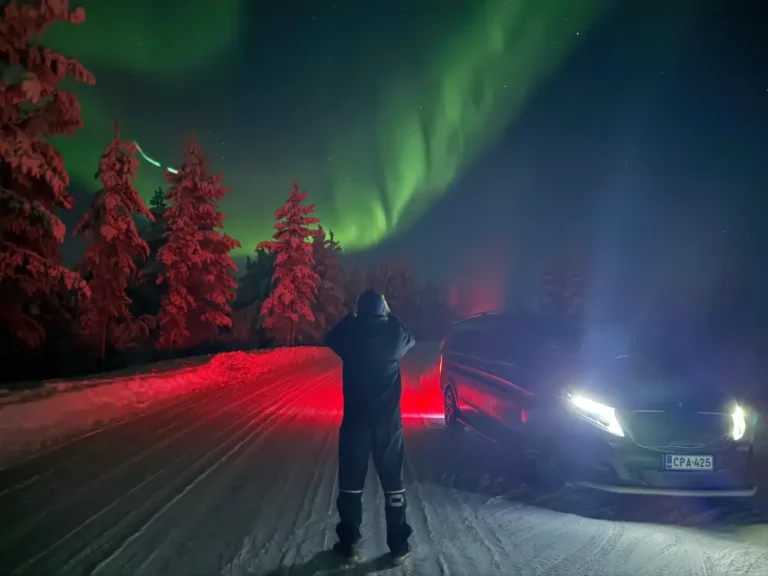
Finnish Lapland is one of the world’s best destinations for Northern Lights hunting because it sits directly beneath the auroral oval, the atmospheric band where solar particles collide with Earth’s magnetic field most intensely. The region combines exceptional geomagnetic activity with vast, unpolluted wilderness, long Arctic nights, and reliable winter snow cover that amplifies the spectacle. This article answers the most important questions travellers ask before planning a private aurora experience in Finnish Lapland.
If you are ready to start planning, explore our Northern Lights tours to see what a private aurora experience in Saariselkä looks like, or book your private aurora hunting tour directly.
Why is Finnish Lapland one of the best aurora locations in the world?
Finnish Lapland sits inside the auroral zone, a band centred roughly between 65 and 72 degrees north latitude where geomagnetic activity is strongest and Northern Lights displays are most frequent. This geographic position means the aurora appears on a significant number of clear nights throughout the winter season, making Lapland one of the most statistically reliable places on Earth to witness the phenomenon.
Beyond location, Finnish Lapland offers conditions that few other aurora destinations can match. The landscape is dominated by ancient boreal forests, frozen lakes, and open fells that stretch for hundreds of kilometres without significant artificial light pollution. This darkness is critical. The fainter, more delicate aurora displays that often go unnoticed in populated areas become clearly visible here.
The region also benefits from a long, stable winter. From late September through March, nights in northern Finland can last anywhere from a few hours to almost twenty-four hours near the solstice. This extended darkness gives aurora hunters far more viewing time each evening than destinations at lower latitudes. Combined with the region’s infrastructure for winter tourism, Lapland manages to offer genuine wilderness access alongside comfortable accommodation and professional guiding services.
- Located directly beneath the auroral oval for maximum geomagnetic exposure
- Minimal light pollution across vast wilderness areas
- Long Arctic nights from late September through late March
- Stable winter conditions with consistent snow cover
- Accessible wilderness with professional guiding and safety infrastructure
What makes a private Northern Lights tour different from a group tour?
A private Northern Lights tour reserves the vehicle, guide, and entire experience exclusively for your own party. No strangers join the group, the schedule adapts to your preferences, and the guide can respond to changing conditions without balancing the needs of unrelated guests. This flexibility is the defining difference between a private aurora hunt and a shared group excursion.
On a standard shared tour, the departure time, route, and duration are fixed in advance. If the sky clears in an unexpected direction or a better location becomes available, the guide cannot easily redirect the group. Private tours remove this constraint entirely. The guide can extend the evening, change location mid-tour, or pause longer at a promising site based solely on what gives your party the best chance of seeing the lights.
Privacy also changes the atmosphere of the experience. Couples, families, and small groups often find that watching the Northern Lights without strangers present creates a far more personal and memorable moment. There is no pressure to keep pace with others, no noise from unfamiliar guests, and no compromise on where to stop or how long to stay.
For those who prefer a more social setting, a small-group Standard Aurora Hunting Tour is also available through Private Snow Safaris, with a limited number of participants to preserve an intimate atmosphere. However, for couples, honeymooners, and families who want the experience entirely to themselves, the private format consistently delivers a more tailored and unhurried evening.
When is the best time to see the Northern Lights in Finnish Lapland?
The best time to see the Northern Lights in Finnish Lapland is from late September to late March, when nights are long and dark enough for the aurora to be visible. The peak months are typically October, November, February, and March, when darkness lasts many hours and the sky is frequently clear. December and January offer the longest nights but can also bring more unsettled weather.
Aurora activity follows an approximately eleven-year solar cycle. In 2026, solar activity remains elevated following the recent solar maximum period, which means geomagnetic storms and strong aurora displays are more frequent than during quieter phases of the cycle. This makes the current season particularly promising for travellers planning a Lapland aurora trip.
Within any given night, the aurora most commonly appears between roughly 9 pm and 2 am local time, though displays can occur at any hour of darkness. Experienced guides monitor aurora forecasts throughout the day and adjust departure times to align with predicted activity windows. Staying flexible with your evening schedule significantly increases your chances of a sighting.
- Best overall months: October, November, February, March
- Longest nights: December and January (but weather can be less predictable)
- Peak viewing hours: Approximately 9 pm to 2 am local time
- Solar cycle advantage in 2026: Elevated solar activity increases the frequency of strong displays
How do guides choose locations for aurora hunting in Saariselkä?
Guides choose aurora hunting locations based on three primary factors: cloud cover and sky clarity, distance from artificial light sources, and the direction and intensity of predicted geomagnetic activity. In the Saariselkä region, local guides draw on years of experience navigating the wilderness to identify spots that consistently offer open skies, minimal light pollution, and safe access in winter conditions.
Cloud cover is the single biggest obstacle to seeing the Northern Lights. Before and during a tour, guides monitor real-time satellite imagery and weather forecasts to track where the sky is clearest. Because Saariselkä sits within a large wilderness area, it is often possible to drive a relatively short distance to find a clear window in the cloud cover. This local mobility is something that fixed-location viewing points cannot offer.
Light pollution is the second key consideration. Even modest sources of artificial light, such as a small village or a hotel complex, can wash out fainter aurora displays. Guides at Private Snow Safaris know the terrain around Saariselkä in detail and select locations that place guests well away from any competing light sources, often on frozen lake shores, open fells, or clearings deep in the boreal forest.
The direction of aurora activity also matters. Strong geomagnetic storms can produce aurora visible across a wide arc of the sky, but quieter displays tend to concentrate near the northern horizon. Choosing a location with an unobstructed view to the north, ideally over open water or flat terrain, maximises what guests can see during lower-activity nights.
What weather and sky conditions affect Northern Lights visibility?
Northern Lights visibility depends primarily on two independent factors: geomagnetic activity in the upper atmosphere and sky clarity at ground level. Both must align for a successful sighting. Strong solar wind can produce a powerful aurora display, but if cloud cover obscures the sky, the lights remain invisible from the ground regardless of how active they are overhead.
Geomagnetic activity is measured using the Kp index, a scale from 0 to 9. In Finnish Lapland, aurorae are typically visible under clear skies from Kp 1 or 2 upwards, meaning even moderate activity can produce a display. Stronger storms, rated Kp 5 and above, generate vivid green, red, and purple curtains that can fill the entire sky and are visible even through thin cloud layers.
Sky conditions in Lapland vary considerably night to night and even hour to hour. High-pressure weather systems bring clear, cold nights that are ideal for aurora viewing. Low-pressure systems carry cloud and sometimes snowfall, which blocks visibility entirely. The transition between these systems can happen quickly, which is why experienced guides monitor forecasts continuously and remain ready to relocate during a tour if conditions shift.
- Geomagnetic activity (Kp index): Higher values mean more intense and widespread aurora
- Cloud cover: The most common barrier to visibility; clear skies are essential
- Moon phase: A full moon can reduce contrast, though it also illuminates the snowy landscape beautifully
- Temperature and humidity: Very cold, dry air typically accompanies clearer skies in Lapland
- Wind direction: Northerly winds often bring clearer conditions to the Saariselkä area
What should you expect during a private aurora hunting experience in Lapland?
During a private aurora hunting experience in Lapland, you can expect door-to-door pickup from your accommodation, transportation in a comfortable premium vehicle, and a guided evening in the wilderness led by a knowledgeable local. The tour follows your group’s pace, includes stops at carefully chosen locations, and typically lasts several hours to maximise the window of potential aurora activity.
The evening begins with pickup directly from your hotel, cabin, or other accommodation in the Saariselkä area. From there, the guide drives to the first selected location based on the night’s weather and aurora forecast. Stops are chosen for sky clarity, darkness, and scenic surroundings. Depending on conditions, the guide may move between two or three locations during the evening to follow the clearest skies.
At viewing stops, guests step out into the Arctic night with warm clothing and, if desired, camera equipment for photography. Private Snow Safaris provides guidance throughout, including tips on photographing the aurora. Depending on the tour, the experience may also include hot berry juice and local snacks beside an open fire, adding warmth and atmosphere to the wilderness setting.
It is important to approach aurora hunting with realistic expectations. The Northern Lights are a natural phenomenon and cannot be guaranteed on any given night. What a professional private tour does guarantee is that every reasonable effort is made to find the best conditions available, that your group is comfortable and safe throughout the evening, and that the experience is personal and unhurried from start to finish.
- Pickup from your accommodation in a premium vehicle
- Travel to carefully selected wilderness locations away from light pollution
- Guided stops with aurora observation and photography opportunities
- Hot drinks and snacks by an open fire (depending on tour)
- Flexible schedule that follows your group’s pace and the night’s conditions
- Return transfer to your accommodation
Finnish Lapland combines geography, darkness, local expertise, and extended winter nights into one of the most compelling aurora destinations on the planet. Whether you are visiting as a couple, a family, or a small group of friends, a private aurora hunting tour in Saariselkä offers the best possible conditions for a genuine and personal encounter with the Northern Lights. Discover our Northern Lights tours to find the right experience for your group, book your private aurora hunting tour to secure your evening in the Arctic wilderness, or contact us with any questions about planning your Lapland experience.