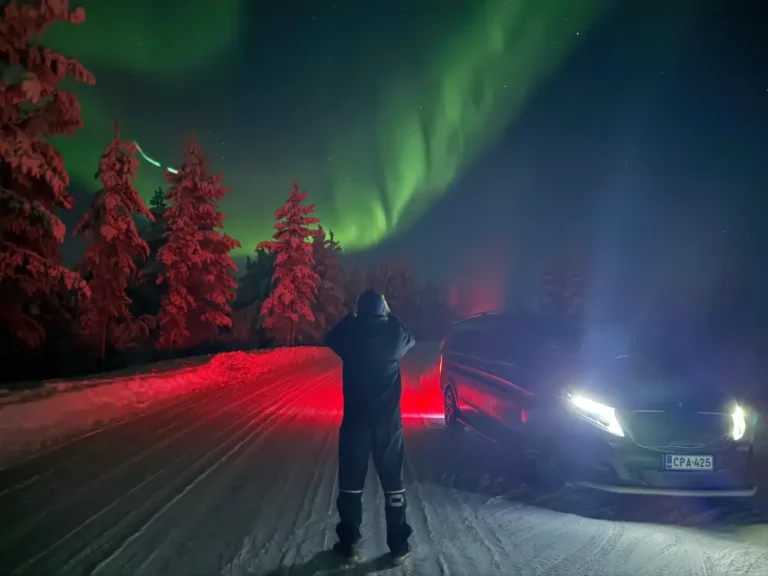
Planning a successful private aurora hunting trip comes down to three things: timing, conditions, and choosing the right guide. Visit Finnish Lapland between late September and late March, monitor cloud cover and solar activity, and book a private tour with a local expert who can drive to clear skies at short notice. The sections below unpack each of these factors in practical detail.
If you are ready to start planning now, explore our Northern Lights tours in Saariselkä or book a private aurora hunting tour directly online.
What conditions do you actually need to see the northern lights?
To see the northern lights, you need three conditions to align simultaneously: sufficient solar activity, clear skies, and genuine darkness. Solar activity is measured using the Kp index, a scale from 0 to 9 that indicates geomagnetic storm intensity. In Finnish Lapland, aurora displays are visible from around Kp 1 or 2 under good conditions, though stronger storms produce more dramatic and colourful curtains of light.
Clear skies are arguably the most decisive factor on any given night. The aurora can be blazing overhead, but a thick layer of cloud will block every trace of it. This is why experienced local guides monitor weather forecasts closely and are prepared to drive to wherever the sky is open. Finnish Lapland’s vast, sparsely populated landscape makes this possible in a way that simply is not feasible in more densely developed destinations.
Darkness matters too. Light pollution from towns, hotels, and ski resorts washes out fainter displays. The best aurora experiences happen well away from artificial lights, in open terrain where your eyes can fully adapt to the dark. A combination of low cloud cover, a Kp index of 2 or higher, and a location far from light pollution gives you the strongest possible foundation for a successful aurora hunting night in Lapland.
- Kp index: Check forecasts on apps like Space Weather Live or My Aurora Forecast. A Kp of 2 or above is a reasonable threshold for Finnish Lapland.
- Cloud cover: Look for hourly cloud forecasts, not just daily summaries. Conditions can change within hours.
- Darkness: Move away from town centres and hotel complexes. Open lakes, fell plateaus, and forest clearings all offer better viewing.
- Moon phase: A full moon brightens the sky and can reduce contrast, though it also creates beautiful light on the snow. A new moon gives the darkest sky.
When is the best time to go aurora hunting in Finnish Lapland?
The best time for aurora hunting in Finnish Lapland is from late September to late March, when nights are long and dark enough for the northern lights to be visible. The peak season runs from November through February, when darkness lasts up to 20 hours per day in the far north. Saariselkä, located above the Arctic Circle, sits in an ideal position for extended viewing windows.
September and October offer a useful combination of reasonable temperatures and increasingly long nights. The landscape is often snow-covered from October onwards, which reflects the aurora beautifully and makes for dramatic photography. March brings longer daylight hours but still delivers dark nights, and the weather tends to be more stable than midwinter, with slightly warmer temperatures that make standing outside more comfortable.
December and January are the darkest months, which maximises your window for aurora visibility each night. However, temperatures can drop to minus 20 or 30 degrees Celsius, which requires proper preparation. February is widely regarded as one of the best months overall: deep snow, reliable darkness, improving weather, and temperatures that are cold but manageable for most visitors.
It is worth noting that the northern lights follow an approximately 11-year solar cycle. In 2026, solar activity remains elevated following the recent solar maximum, which means geomagnetic storms are more frequent and aurora displays tend to be more intense than in quieter periods of the cycle. This makes aurora hunting in Finnish Lapland particularly rewarding right now.
Why does a private aurora tour give you a better chance than a group tour?
A private aurora tour gives you a better chance of seeing the northern lights because the entire experience is built around flexibility. When you travel with only your own party, your guide can change location instantly if cloud moves in, extend the night if conditions improve late, or return early if the display peaks ahead of schedule. A large shared group cannot operate this way without disrupting everyone on board.
On a shared group tour, decisions are made for the majority. If most passengers want to return to the hotel at a set time, the tour ends regardless of what the sky is doing. If cloud clears over a different location 30 kilometres away, a full coach cannot simply redirect without significant logistical consequences. A private vehicle with your own party faces none of these constraints.
There is also a qualitative difference in the experience itself. Aurora hunting is an intimate, often emotional encounter with nature. Sharing it with strangers changes the atmosphere. A private tour allows couples, families, and small groups to experience the moment together, at their own pace, without noise or interruption from others. Guides can also focus entirely on your group’s interests, whether that means photography advice, explanations of the science behind the lights, or simply standing quietly in the Arctic silence.
Private Snow Safaris reserves the vehicle and guide exclusively for your party on every private aurora hunting tour. No unfamiliar guests are added. The route, timing, and stops are shaped around your preferences and the conditions on the night, not a fixed itinerary designed for the average customer. See how our Northern Lights tours work and what is included in each option.
How should you prepare for a night out aurora hunting in the Arctic?
Preparing for an Arctic aurora hunting night means dressing in proper thermal layers, protecting your hands and face, and setting realistic expectations about the experience. Temperatures in Finnish Lapland regularly fall below minus 15 to minus 25 degrees Celsius in midwinter, and standing outside for extended periods in that cold requires more insulation than most visitors initially expect.
Clothing and warmth
The most important principle is layering. Start with a moisture-wicking base layer, add an insulating mid-layer such as fleece or down, and finish with a windproof and waterproof outer shell. Wool or synthetic thermal socks, insulated boots rated for extreme cold, and a hat that covers your ears are essential. Mittens are warmer than gloves for standing still outdoors. Many reputable tour operators provide thermal overalls and boots if you do not have your own gear.
Your face and extremities lose heat fastest. A balaclava or neck gaiter, combined with ski goggles or, at minimum, a good pair of sunglasses, protects against wind chill. Hand warmers in your pockets add a useful backup layer of warmth during long stops.
Camera and battery preparation
Cold temperatures drain camera and phone batteries very quickly. Carry a spare battery kept warm in an inner pocket and swap it in when the primary battery drops. For aurora photography, a camera that allows manual settings, a wide-angle lens with a low aperture, and a sturdy tripod are the core requirements. Your guide can advise on settings on the night, but practising in advance helps.
Beyond equipment, prepare mentally for variability. The northern lights are a natural phenomenon, and no one can guarantee they will appear on a specific night. Arriving with patience and an open attitude, rather than a rigid expectation, makes the experience far more rewarding regardless of what the sky delivers.
What should you look for when choosing a private aurora tour operator?
When choosing a private aurora tour operator in Finnish Lapland, prioritise local knowledge, genuine flexibility, and transparent communication about what is and is not guaranteed. The best operators are based in the region, know the terrain intimately, and can reach multiple alternative viewing locations depending on where the sky is clearest on any given night.
Ask specific questions before booking:
- Is the tour truly private? Confirm that no other guests will be added to your vehicle or group. Some tours marketed as private are actually small shared groups.
- How flexible is the itinerary? A good operator will adjust timing, duration, and location based on live weather and aurora forecasts, not a fixed schedule.
- What is included? Look for thermal clothing, warm drinks, comfortable transportation, and a knowledgeable guide as standard, not as expensive add-ons.
- How does the operator handle poor conditions? Ask about their rebooking or refund policy if cloud makes aurora viewing impossible.
- Do they know the local area? Guides who live and work in the region year-round understand Arctic conditions, seasonal patterns, and off-road access to dark-sky locations in a way that visiting operators simply cannot replicate.
Reviews from previous guests are a strong signal of quality. Look for specific mentions of guide knowledge, flexibility on the night, and how the operator handled evenings when conditions were difficult. A company that communicates honestly about the unpredictability of the northern lights and still delivers a memorable experience is far more trustworthy than one that makes unrealistic promises.
Local expertise, a private vehicle reserved exclusively for your party, and a guide who monitors conditions in real time are the foundation of a successful aurora hunting trip in Finnish Lapland. If you are planning your Lapland visit and want to experience the northern lights on your own terms, book your private aurora hunting tour with Private Snow Safaris, or get in touch to discuss a tailored experience for your group.
Related Articles
- Should you book a private or small-group aurora hunting tour?
- Private aurora hunting designed around your schedule and ideal conditions
- Exclusive private aurora hunting built for serious northern lights seekers
- Can you increase your chances of seeing auroras privately?
- How to dress for a Northern Lights Safari in Saariselkä?