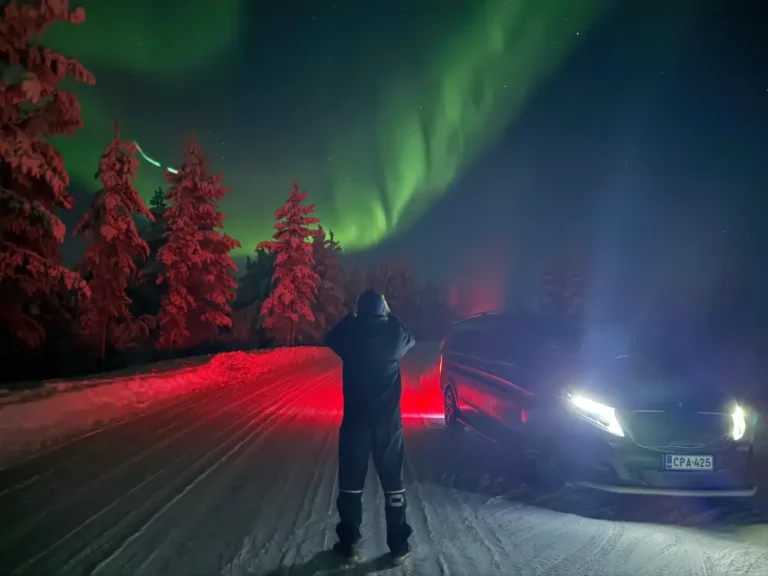
Aurora guides predict Northern Lights activity by combining real-time space weather data, local cloud cover forecasts, and on-the-ground knowledge of the terrain. They monitor solar wind speed, geomagnetic storm indices, and satellite imagery throughout the day and evening, adjusting plans as conditions evolve. The sections below unpack each part of that process, from the tools guides use to what guests should realistically expect on a tour night.
If you want to experience this process firsthand, explore our Northern Lights tours in Saariselkä and see how local expertise shapes every evening in the field. You can also book a private aurora hunting tour directly and reserve an evening exclusively for your own group.
What tools and data sources do aurora guides actually use?
Aurora guides rely on a combination of space weather services, satellite cloud imagery, and local observation networks. The most commonly used data sources include real-time solar wind readings from instruments monitoring the sun’s output, geomagnetic activity indices, and weather satellite feeds that show cloud cover moving across Lapland. No single tool tells the whole story, so experienced guides cross-reference several sources before and during a tour.
In practice, a guide preparing for an evening in the field will typically check the following:
- Space weather forecasts from agencies such as NOAA’s Space Weather Prediction Center, which publish solar wind data, coronal mass ejection alerts, and geomagnetic storm watches
- The KP index forecast, a standardized scale measuring geomagnetic disturbance, updated every three hours
- Satellite cloud imagery showing real-time and short-range cloud movement across Finnish Lapland
- Local weather station data for temperature, wind direction, and visibility in the Saariselkä region specifically
- Aurora alert apps and networks that aggregate space weather data into simplified notifications
What separates an experienced local guide from a casual aurora watcher is knowing how to read these tools together. A promising KP forecast means little if a wall of cloud is moving in from the west. Conversely, a modest KP reading on a perfectly clear, dark night can still produce a vivid display. Guides build this judgment over many seasons of watching conditions in the same region.
How far in advance can Northern Lights activity be predicted?
Aurora activity can be predicted with reasonable confidence roughly one to three days in advance, and with greater precision in the final hours before a display. Long-range forecasts beyond three days carry significant uncertainty because solar activity is inherently variable. The most reliable window for aurora prediction is the 30 to 90 minutes after a solar wind event reaches Earth’s magnetic field.
This timeline matters for tour planning in a practical way. Guides begin assessing the outlook two to three days ahead to identify promising nights, but the final decision about where to go and when to depart is made on the day of the tour, sometimes as late as early evening. This is one reason why flexibility is so important in aurora hunting. A rigid, fixed-time group tour cannot easily adapt to a forecast that shifts during the afternoon. A private tour, by contrast, can adjust departure time, extend the evening, or change location as the night develops.
For guests planning a Lapland trip, the practical implication is to allow several nights in the destination rather than relying on a single outing. Even with the best forecasting tools, no guide can guarantee a display on a specific date.
What does the KP index actually mean for a tour night?
The KP index is a scale from 0 to 9 that measures the level of geomagnetic disturbance in Earth’s atmosphere. A higher KP value means stronger geomagnetic activity and, in theory, a greater chance of visible aurora. At the latitude of Finnish Lapland, Northern Lights can appear even at KP 1 or 2 on a clear, dark night, while a KP 5 or above indicates a geomagnetic storm that may produce vivid, wide-reaching displays.
However, guides treat the KP index as one signal among several rather than a definitive verdict. A KP of 4 under heavy cloud cover produces nothing visible. A KP of 2 on a perfectly clear, moonless night in the Arctic wilderness can produce a memorable display. The index also updates every three hours, so a KP reading taken at 9 p.m. may not reflect conditions at midnight.
For guests, the most useful way to think about KP is as a background indicator of solar conditions rather than a guarantee of what the sky will show. Your guide interprets this number alongside cloud forecasts, local visibility, and real-time satellite data to make decisions about the evening. The KP index is a starting point, not a conclusion.
How does cloud cover affect aurora hunting more than solar activity?
Cloud cover is the single biggest factor determining whether guests see the Northern Lights on any given night, outweighing solar activity in most practical scenarios. Even a powerful geomagnetic storm producing KP 7 or 8 will be completely invisible beneath a solid overcast sky. In Finnish Lapland, cloud systems can move quickly, and a guide’s ability to read and chase clear patches is often what separates a successful evening from a blank one.
This is why local knowledge of the terrain matters so much in aurora hunting. The Saariselkä region sits in a part of Lapland where cloud cover can vary significantly across relatively short distances. A guide who knows the area can identify which direction clear skies are tracking, estimate how long a gap in the clouds might hold, and drive the group to a location where visibility is best. This kind of real-time repositioning is impossible on a fixed-route group tour.
Guests often arrive expecting that a high KP forecast guarantees a sighting. In reality, experienced guides spend more of their preparation time studying cloud satellite imagery than space weather data. On a night with modest solar activity but clear skies, the aurora can be vivid and prolonged. On a night with exceptional solar conditions but persistent cloud, there is nothing to see. Clear skies are the prerequisite for everything else.
How does a private guide choose the right location on the night?
A private aurora guide selects viewing locations based on three overlapping factors: the direction of clear sky openings, the absence of artificial light pollution, and safe, accessible terrain. These decisions are made dynamically throughout the evening rather than following a predetermined route. The guide monitors cloud movement, checks satellite imagery from the vehicle, and adjusts the destination as conditions develop.
In the Saariselkä area, guides have a range of established locations they know well from experience, including frozen lakes, open fell terrain, and forest clearings that offer wide sky views with minimal light interference. The choice between these sites depends on which direction offers the clearest sky on a given night. A location that works perfectly when cloud is moving from the south may be blocked when weather comes from the northwest.
On a private aurora hunting tour, the guide can make these decisions without the constraints of a group timetable or a fixed return schedule. If the sky opens up in an unexpected direction, the group can move. If conditions improve later in the evening, the tour can extend. This flexibility is one of the core advantages of private aurora hunting over shared group excursions, where the schedule is set regardless of what the sky is doing.
What should guests realistically expect from a guided aurora tour?
Guests on a guided aurora tour should expect a well-organized, comfortable evening in the Arctic wilderness with a knowledgeable local guide, but should not expect a guaranteed sighting. The Northern Lights are a natural phenomenon driven by solar and atmospheric conditions that no guide, tool, or forecast can control. What a guide can do is maximize the chances of a sighting by choosing the right night, the right location, and the right moment to be outside watching the sky.
In practical terms, here is what a well-run private aurora tour typically includes:
- Pickup from your accommodation in a comfortable, heated vehicle at a time chosen around current conditions rather than a fixed clock
- Real-time guidance as the guide monitors forecasts, cloud cover, and aurora alerts throughout the evening
- Movement between locations if cloud cover or conditions require repositioning
- Photography stops with time to set up and capture both the aurora and the Lapland landscape
- Warm clothing, hot drinks, and snacks to keep the group comfortable during outdoor stops
- A flexible schedule that can extend the evening if conditions improve later
What guests should understand going in is that some nights produce spectacular displays and some do not, regardless of how well the tour is organized. Guides with deep local knowledge improve the odds significantly, but they cannot override the weather or the sun. The most satisfied guests are those who come prepared to enjoy the Arctic night itself, with the aurora as a hoped-for highlight rather than a guaranteed centrepiece.
If you are planning a trip to Finnish Lapland and want to give yourself the best possible chance of seeing the Northern Lights, learn more about our aurora tours and how each evening is planned around your group’s preferences and the night’s conditions. For a fully private experience with no strangers and a schedule built around you, book your private aurora hunting tour in Saariselkä. For questions about specific dates, availability, or what to expect during your stay, get in touch with us directly and we will help you plan your evening in the Arctic.
Related Articles
- What is the aurora forecast and how does it affect your tour?
- What makes Finnish Lapland ideal for private Northern Lights hunting?
- Private aurora hunting designed around your schedule and ideal conditions
- Where Is the Best Place to See the Northern Lights Near Saariselkä?
- Book your private aurora hunt and witness nature's greatest light show